Shopping online is a visual experience. Before a customer reads a single product detail, they've already absorbed the look and feel of your site. Typography is a huge part of that first impression, and the font you choose for headings, product titles, and body copy influences how trustworthy, premium, or approachable your store feels. Garamond is a classic serif typeface that many ecommerce designers reach for when they want elegance without stuffiness. But Garamond alone isn't enough the fonts you pair with it determine whether your site looks polished or cluttered. This article breaks down exactly how to pair Garamond for ecommerce website typography so your store looks sharp and converts better.
What does Garamond pairing mean for an ecommerce store?
Garamond pairing is the practice of combining Garamond with one or more complementary typefaces across your website. In ecommerce, this usually means using Garamond for either headings or body text and pairing it with a second font for the other role. The goal is visual contrast and readability. A serif like Garamond carries a sense of tradition and quality, while a clean sans-serif handles navigation, buttons, and UI labels. Together, they create a typographic system that feels both refined and functional.
For online stores, this matters more than most people think. Product pages, category listings, checkout flows, and email confirmations all rely on type to communicate. If your fonts clash or feel inconsistent, visitors notice even if they can't articulate why. Good pairing removes friction and builds confidence in your brand.
Why does font pairing affect conversions and trust?
Typography sets the tone for your entire shopping experience. A luxury jewelry store using a playful display font sends mixed signals. A tech gadget shop using an overly ornate serif feels out of touch. Garamond works well for ecommerce because it sits in a sweet spot it's elegant enough for premium products but readable enough for everyday use.
When you pair it correctly with a complementary font, you create clear visual hierarchy. Customers can scan product titles, prices, descriptions, and calls to action without confusion. Research from MIT's AgeLab found that font readability directly affects how long people stay on a page. Longer time on page often correlates with higher purchase intent. So the right Garamond pairing isn't just aesthetic it's practical.
Which fonts pair best with Garamond for online stores?
Garamond is a serif with moderate contrast and gentle curves. It pairs best with sans-serif fonts that offer clean geometry or humanist warmth. Here are strong options:
- Helvetica A neutral, widely recognized sans-serif. It lets Garamond do the talking in headlines while handling UI elements with quiet confidence. The Helvetica and Garamond combination works well for modern, clean storefronts.
- Futura Geometric and sharp. It contrasts Garamond's organic curves with structured simplicity. If your brand leans minimal or design-forward, this Futura pairing is worth exploring.
- Open Sans Friendly and highly legible at small sizes. Great for product descriptions, reviews, and footer text where clarity matters most.
- Montserrat A geometric sans with enough personality to stand next to Garamond without disappearing. Works nicely for fashion, beauty, and lifestyle brands.
- Roboto Clean, versatile, and optimized for screens. A safe choice if your store runs on platforms that load system fonts quickly.
For a deeper look at combining Garamond with sans-serif options, you can read more about pairing Garamond with sans-serif fonts for web design.
How should you assign Garamond and its partner font across your site?
A common approach for ecommerce is to use one font for display purposes and another for functional text. Here's a practical breakdown:
- Headlines and product titles: Garamond in a larger size (24–36px on desktop) gives product pages a refined, editorial quality.
- Body copy and descriptions: A sans-serif like Open Sans or Helvetica at 14–16px keeps paragraphs easy to read, especially on mobile.
- Navigation and buttons: Sans-serif in all caps or small caps works well for menus, cart labels, and CTAs.
- Prices and sale badges: Bold weight of your sans-serif draws attention without competing with the product title.
You can also reverse the arrangement using Garamond for body text with a sans-serif headline if your brand feels more contemporary. The key is consistency. Pick a role for each font and stick with it across every page.
What common mistakes do ecommerce sites make with Garamond?
Several issues come up repeatedly when stores try to implement Garamond:
- Using Garamond at very small sizes on screens: At 12px or below, Garamond's thin strokes can disappear, especially on low-resolution displays. Keep body text at 15px minimum for web use.
- Pairing with another serif: Combining Garamond with a second serif like Times New Roman creates visual monotony and makes the hierarchy unclear.
- Ignoring font weight contrast: If both fonts are light or regular weight, the page feels flat. Use bold or semibold for at least one font to create depth.
- Skipping font loading optimization: Garamond web fonts can be heavy. Not using font-display: swap or subsetting causes slow load times, which hurts both user experience and SEO.
- Inconsistent usage across devices: Testing only on desktop and ignoring how the pairing looks on phones and tablets leads to broken layouts and unreadable text on smaller screens.
How do you test a Garamond pairing before committing to it?
Before launching a new type system across your entire store, test it on real pages. Build a prototype of your product listing page, a single product page, and your checkout flow using the Garamond pairing you're considering. Check these things:
- Can you read every piece of text comfortably on a phone screen?
- Is there a clear visual difference between headings, body text, and UI elements?
- Do the fonts load within two seconds on a standard connection?
- Does the overall feel match what you'd expect from your brand?
- Do the fonts hold up in both light and dark color schemes?
Ask three or four people who match your target customer to browse the prototype and give honest feedback. Their reactions will tell you more than any font theory.
Practical tips for getting Garamond ecommerce pairings right
- Limit yourself to two fonts maximum. More than two creates visual noise on product pages.
- Match x-heights roughly. Garamond has a relatively low x-height, so choose a partner font with a similar proportion or adjust sizes to compensate.
- Use web-safe fallbacks. Always include a sensible fallback stack like "Georgia, Times, serif" for Garamond and "Arial, Helvetica, sans-serif" for your sans-serif.
- Check licensing. Not all Garamond versions are free for commercial use. Verify your license covers web embedding.
- Subset your fonts. Remove unused character ranges to reduce file size and speed up loading for your store.
- Test checkout pages specifically. Typography that looks great on a marketing landing page might fall apart on a dense checkout form. Pay attention to input fields, error messages, and small legal text.
Quick checklist: launching Garamond pairing on your ecommerce site
- Choose your Garamond version and verify the web font license
- Pick one complementary sans-serif that matches your brand personality
- Define roles: which font handles headlines, body, nav, and buttons
- Set minimum font sizes (15px+ for body, 24px+ for headlines)
- Build a prototype of at least three key pages (PLP, PDP, checkout)
- Test on mobile, tablet, and desktop screens
- Optimize font files with subsetting and font-display: swap
- Run the prototype by real users before going live
- Document your type system so every team member uses it consistently
Next step: Pick your top two font candidates, build a quick product page mockup with real product photos and copy, and share it with five people in your target audience. Their feedback what feels premium, what feels hard to read, what feels off-brand will guide your final decision far better than guessing.
Explore Design How to Pair Garamond with Sans Serif Fonts for Websites
 Best Garamond Companion Fonts for Responsive Web Design
 Garamond Web Font Pairing Rules and Best Practices for Designers
 Garamond and Helvetica Font Pairing for Modern Web Design
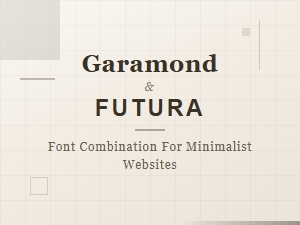 Garamond and Futura Font Pairing for Minimalist Website Design
 Garamond Pairing Guide for Minimalist Website Typography